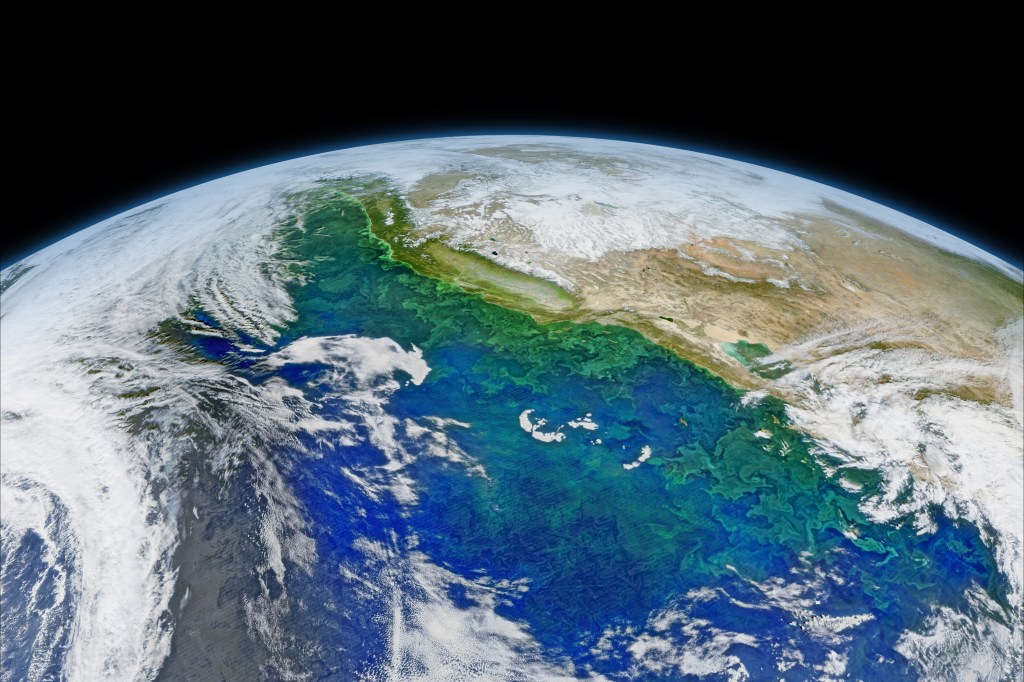
The global ocean is a magnificent feature of the Earth’s surface. Often referred to as ‘primordial soup’, the global ocean hosts all of the necessary parameters for complex life to emerge if given enough time and climatic stability. The state of our global oceans is changing at a rate never before observed in earth history as a result of human fossil fuel emissions, deforestation, and ultimately, climatic instability [1]. Our oceans act as a buffer that resists drastic changes in global temperature by absorbing and storing vast amounts of energy. As a result, oceans absorb much of the energy that is recycled by the increasing greenhouse effect and are thus increasing in temperature. As ocean temperatures rise, the concentration of dissolved oxygen in the oceans decreases, resulting in deoxygenation. Furthermore, around 30% of the carbon dioxide emitted by humans is dissolved into the ocean, which alters the ocean’s carbonate chemistry towards a more acidic environment. This acidification is most pronounced in polar oceans, because carbon dioxide dissolves more readily in colder waters, but the effects can be observed in ocean regions where cold, deep-ocean water travels to the surface in a process called upwelling. As it so happens, California’s coastline is one of these upwelling regions. As the thermodynamic and chemical properties of the primordial soup change relatively rapidly, biologically productive ecosystems, from coral reefs to kelp forests and even river deltas, are faced with an insurmountable challenge: evolve quickly or perish.
It is useful to understand California’s coastal waters in terms of currents and their relative properties. The dominant currents are the California Current (CC), which consists of the southward movement of relatively cold, low-nutrient surface water along the west coast of North America, extending from British Columbia to Baja California, and the California Undercurrent (CUC), which consists of the poleward movement of relatively warm, high-nutrient bottom water along the west coast of North America.
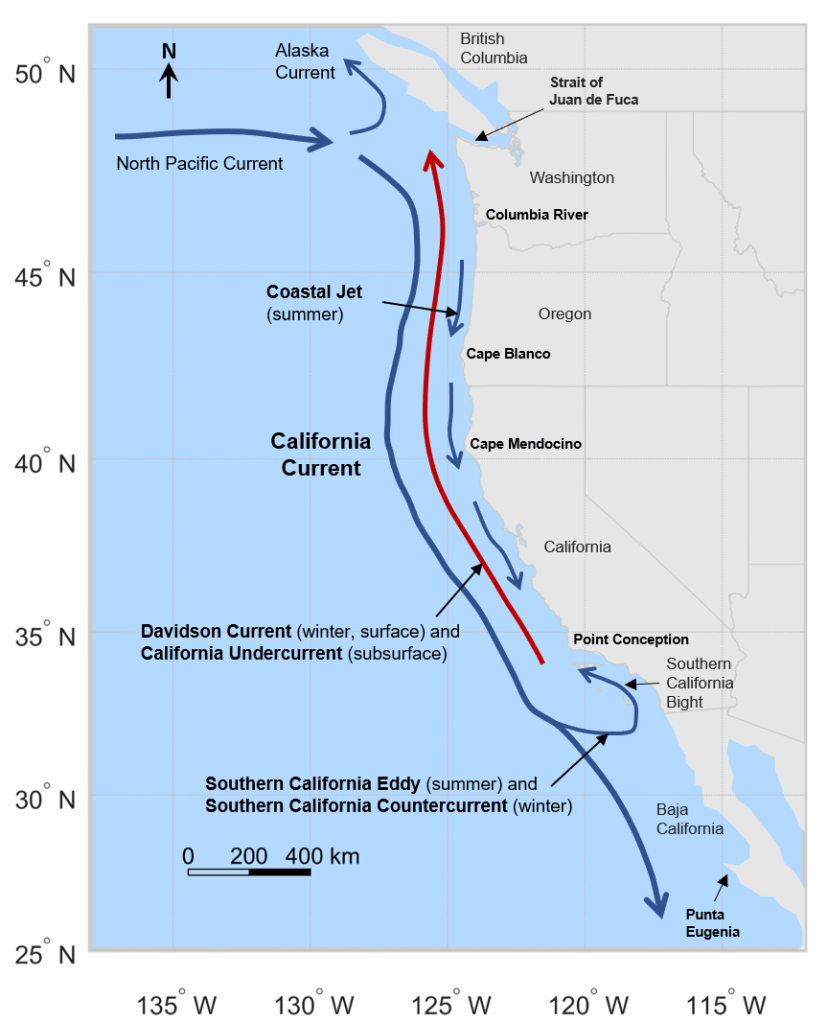
The CC is susceptible to acidification due to its origin in cold, sub-polar waters and constant interaction with atmospheric gases [2]. The CUC is particularly susceptible to both deoxygenation and acidification, due to its origin in warm, tropical waters and its cold, pressurized journey on the ocean floor [3]. The highly variable upwelling of cold, deep ocean water that occurs along the west coast of North America is derived from the CUC and mixes with the CC and lesser currents once it reaches the ocean surface [3]. As a result, observations in the southern CC show decreasing dissolved oxygen concentrations of 1-2 µmol/kg per year and hypoxic events are becoming more frequent in the northern CC [4]. This observation is also driven by the nutrient load that upwells with the CUC water. Blooms of phytoplankton and other microorganisms result from these eutrophic conditions and strip the water of oxygen, further exacerbating the frequency and magnitude of hypoxic events [2].
It has been much more difficult to observe and predict definitive changes in ocean acidification for a couple reasons [2]. The first is that the ocean’s carbonate chemistry experiences a buffering phenomena, which can make the rate of acidification temporally variable and adds uncertainty in discerning a trend. The second is that many models fail to capture a high-enough level of detail necessary to predict fine-scale ocean-atmosphere interactions related to ocean circulation [2]. However, common sense speculation guides an understanding that the buffering phenomena will act similarly to a titration experiment, in which there is a threshold where the buffer fails and rapid acidification ensues.
The future of coastal ecosystems along the California coast under deoxygenated and acidic conditions could have major implications for the biological productivity of the region, and thus economic interests in seafood. Due to the complexity of marine environments, in that many environmental and human factors influence biological productivity, any claims about the region remain speculative. The main takeaway is that ocean deoxygenation and acidification are mechanisms that impose stress on a wide variety of marine life, and makes it harder for certain species, like calcifying corals and plankton, to survive. Overfishing is the main threat to California’s coastal waters, since it is a mechanism that works rapidly relative to ocean deoxygenation and acidification and can exacerbate many other mechanisms by reducing a species evolutionary potential in the face of climate change. Further research to understand the effects that ocean deoxygenation and acidification have on marine life is necessary to providing concrete evidence of the benefits that could come by divesting from fossil fuels. Furthermore, this research needs to be large-scaled and multi-factored in order to capture the complexity of the marine environment.
It is notable, however, that historical climate records indicate that ocean deoxygenation and acidification were prominent kill mechanisms for the late-Permian extinction, which is estimated to have killed 70% of terrestrial life and 95% of marine life [5,6,7]. These mechanisms coincide with a particularly massive continental eruption in modern day Siberia that spewed an estimated 100,000 gigatons of carbon dioxide and methane into the atmosphere over a short period of geologic time [4]. As human fossil fuel emissions go unchecked, the annual release of CO2 by humans supersedes the annual release by volcanism during the late-Permian period. It is not unreasonable to say that an alien race studying the Earth’s geology might mistake ancient human civilization for a brief bout of volcanism that ended in mass extinction.
References:
- Caldeira, K., & Wickett, M. (2003). Anthropogenic carbon and ocean pH. Nature, 425, 365.
- Bakun, A., Black, B. A., Bograd, S. J., García-Reyes, M., Miller, A. J., Rykaczewski, R. R., & Sydeman, W. J. (2015). Anticipated Effects of Climate Change on Coastal Upwelling Ecosystems. Current Climate Change Reports, 1(2), 85–93. https://doi.org/10.1007/s40641-015-0008-4
- Stone, H. B., Banas, N. S., & MacCready, P. (2018). The Effect of Alongcoast Advection on Pacific Northwest Shelf and Slope Water Properties in Relation to Upwelling Variability. Journal of Geophysical Research: Oceans, 123(1), 265–286. https://doi.org/10.1002/2017JC013174
- Bograd, S. J., Buil, M. P., Lorenzo, E. D., Castro, C. G., Schroeder, I. D., Goericke, R., et al. (2015). Changes in source waters to the Southern California Bight. Deep Sea Research Part II: Topical Studies in Oceanography, 112, 42–52. https://doi.org/10.1016/j.dsr2.2014.04.009
- Garbelli, C., Angiolini, L., & Shen, S. (2017). Biomineralization and global change: A new perspective for understanding the end-Permian extinction. Geology, 45(1), 19–22. https://doi.org/10.1130/G38430.1
- Hinojosa, J. L., Brown, S. T., Chen, J., DePaolo, D. J., Paytan, A., Shen, S., & Payne, J. L. (2012). Evidence for end-Permian ocean acidification from calcium isotopes in biogenic apatite. Geology, 40(8), 743–746. https://doi.org/10.1130/G33048.1
- Cui, Y., & Kump, L. R. (2015). Global warming and the end-Permian extinction event: Proxy and modeling perspectives. Earth-Science Reviews, 149, 5–22. https://doi.org/10.1016/j.earscirev.2014.04.007
 California Climate Change