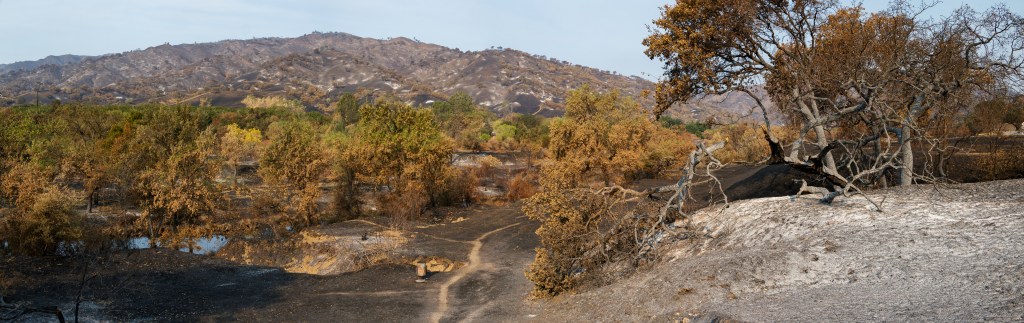
In the last five years, California has experienced record-breaking wildfires, creating orange skies and apocalyptic scenes each fall. The five largest wildfires since 1932, when accurate record-keeping began, have occurred since 2017. 2017 saw the Thomas fire burn 280,000 acres in December. 2018 saw the Mendocino Complex and Carr fire burn 688,000 acres in July. 2020 has seen the LNU, SCU, North, and August Complexes burn over 2 million acres in August and the Creek fire burn 311,000 acres in September [1]. Why is this happening?
The reality of California’s environment is that it’s hostile. Due to the Mediterranean climate, the landscape is prone to wildfires; nearly all the rain occurs in the winter and all the new vegetation growth dries out in the autumn. As the state recently witnessed, a single lightning storm in autumn will ignite entire portions of the state. Fire is so prominent in Californian ecology that forests have adapted evolutionarily. Californian Redwoods shed low-lying branches to prevent fire from climbing up the tree into the canopy. They have thick insulating bark that shields their trunks from the fires that burn through the undergrowth [2]. Californian Sequoias have similar adaptations and even rely on the heat of wildfires to open their cones to release seedlings. Estimates of California’s wildfire extent before Euro-American settlement range between 1.8-4.4 million acres annually [3]. Fire ecology is an integral component of California’s environment and so naturally it should guide the state and federal discussion on forest-land vegetation management in California, but it doesn’t.
What has guided forest-land vegetation management is wildfire suppression policy, which is not very surprising since wildfires destroy homes and businesses, kill people, and pollute the air. The short term benefit of fire suppression policy is briefly sparing those things. The long term consequences are the massive, out of control fires that have popped up in the last five years. Suppressing wildfires in our forests allows too much new growth, which is normally cleared every few years, to build up and provide large swaths of fuel for wildfires to consume when they are inevitably started.
Climate change plays a significant role here. Californian climate change is resulting in autumns that are increasingly wildfire prone [4]. A perfect combination for fires occurs as winter storms become more intense and autumns become drier and warmer. Annual plants, like grasses, are able to grow much faster and larger during the winter season and come autumn these plants dry out and are the perfect kindling for lightning and human-accidents to start wildfires. These conditions are increasing the likelihood that Northern and Southern California will experience extreme wildfire conditions simultaneously in the future [4], which is concerning because our firefighting force is already understaffed and relies on prison labor to undertake certain basic firefighting duties.
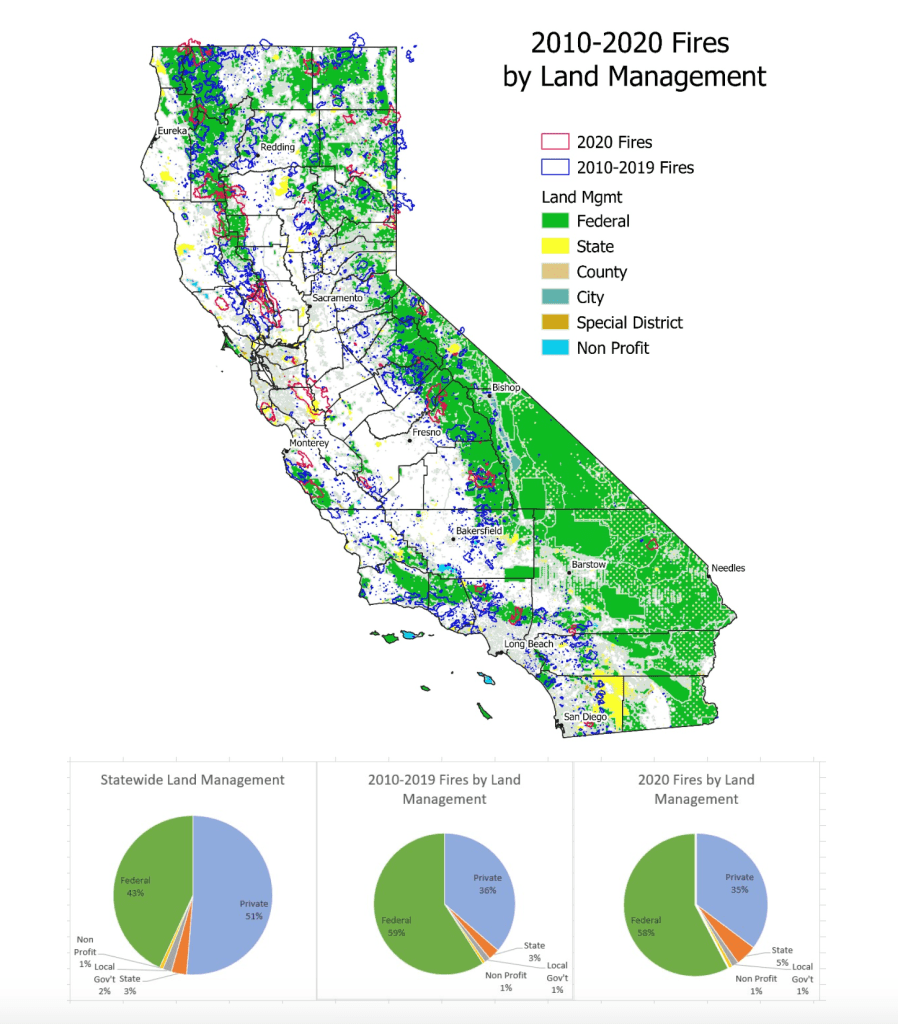
In essence, the private, state and federal vegetation management of California’s forests has tried to ignore the inevitability fire ecology and now climate change is enhancing this fire ecology. In reality, private land owners and the federal government are at the most fault for poor vegetation management. In a rough GIS analysis of fires from 2010-2020, it is revealed that 35-36% of the area burned in fires occurred on private land and 58-59% occurred on federally owned land. So while the federal government is partially correct in its diagnosis of poor vegetation management, the majority of the responsibility still falls on the federal government to follow through with the prescription of better vegetation management.
There is a definitive need for smarter forest-land vegetation management policies and urban planning, along with urgent action on climate change that all need to be implemented if this problem is going to be solved. These policies need to be spearheaded by the federal government, otherwise California will continue to burn. Some basic policies include:
- Increases in prescribed burning (a technique widely used by Indigenous Californians)
- Mandatory fire insurance
- Policies to only suppress fire when infrastructure is threatened
- Divesting from the fossil fuel industry and the decarbonization of electricity production and transportation
References:
- “Top 20 Largest California Wildfires” (PDF). CAL FIRE. Retrieved 10 September 2020.
- Bond, W., & Keeley, J. (2005). Fire as a global ‘herbivore’: the ecology and evolution of flammable ecosystems. Trends in Ecology & Evolution, 20(7), 387–394. https://doi.org/10.1016/j.tree.2005.04.025
- Stephens, S. L., Martin, R. E., & Clinton, N. E. (2007). Prehistoric fire area and emissions from California’s forests, woodlands, shrublands, and grasslands. Forest Ecology and Management, 251(3), 205–216. https://doi.org/10.1016/j.foreco.2007.06.005
- Goss, M., Swain, D. L., Abatzoglou, J. T., Sarhadi, A., Kolden, C. A., Williams, A. P., & Diffenbaugh, N. S. (2020). Climate change is increasing the likelihood of extreme autumn wildfire conditions across California. Environmental Research Letters, 15(9), 094016. https://doi.org/10.1088/1748-9326/ab83a7
 California Climate Change